
6339 S Wentworth Ave, Chicago, IL 60621 BBB A+ Rated • Since 1958
Mon–Fri 8:30am–5pm  |  Sat 8:30am–1pm 773-483-2626
News & Automotive Guides

Auto Parts Blog & Insights

Expert tips, maintenance advice, and buying guides for quality used auto parts, engines, transmissions, and vehicle recycling in Chicago.

0%

Choosing the right automotive lighting in 2026 requires more than comparing brightness, styling, or price. Headlights and Taillights influence night visibility, driver confidence, and how clearly a vehicle communicates with surrounding traffic. Global buyers also face different road layouts, climate conditions, vehicle designs, and regional equipment requirements.

This guide examines practical lighting choices for cars, trucks, SUVs, and specialty vehicles. It considers beam control, light color, weather resistance, installation quality, thermal management, and long-term reliability. A well-designed headlight should illuminate road edges without creating unnecessary glare. A dependable taillight should remain visible through rain, dust, and sudden braking situations. Small details matter, such as sealed connectors, stable mounting points, and evenly distributed illumination.

Real-world use can challenge laboratory claims. A lamp that looks powerful in a showroom may perform poorly on a wet road. An attractive smoked lens may reduce visibility. Brightness alone is not enough. Buyers should verify vehicle compatibility, regional approval requirements, wiring design, and professional installation support before purchasing. Products may also perform differently after months of vibration and temperature changes.

No single lighting system suits every market or driver. That limitation deserves attention. This overview combines technical considerations, user experience, and manufacturer information to support more informed decisions. It does not replace local inspection advice or qualified automotive technicians. For global buyers, the safest choice is usually balanced performance, clear documentation, and consistent reliability rather than the most aggressive-looking product.
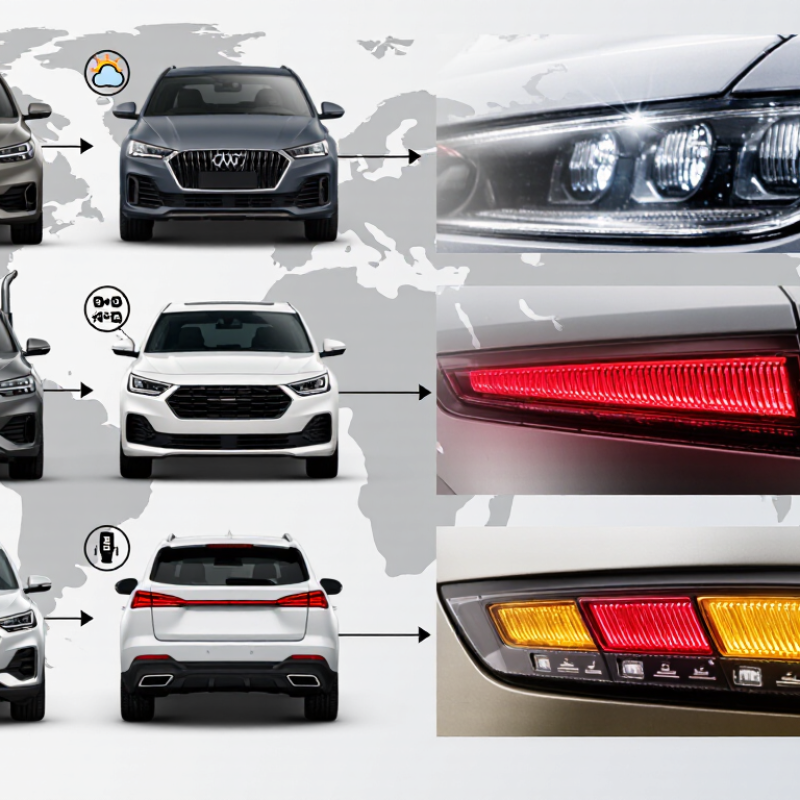
2026 Best Headlights and Taillights for Global Buyers

Headlight and Taillight Types for Different Vehicle Applications

2026 Best Headlights and Taillights for Global Buyers

Headlight and Taillight Types for Different Vehicle Applications

Choosing lighting begins with the vehicle, not the product photograph. Passenger cars often use compact LED headlights for clear beams, lower energy use, and flexible styling. Halogen units remain practical for older vehicles and simple repairs. Some drivers still prefer their warmer light. Large trucks need stronger housings, wider beam coverage, and reliable heat control. Their lamps face vibration, dust, rain, and long operating hours. For buses, sealed LED assemblies can reduce maintenance during frequent urban service.

Off-road vehicles require protected lenses and firm mounting points. A bright lamp is not enough. Its beam must avoid excessive glare on uneven roads. Motorcycles need lightweight headlights, compact taillights, and stable connectors. Electric vehicles benefit from efficient LED systems because every electrical load affects available range. Taillights should provide clear braking, turning, and reversing signals. LED designs react quickly, while traditional bulbs may be easier to replace in remote areas. Each choice has a weakness.

I have seen a nearly perfect replacement fail because its connector was different. Check voltage, dimensions, beam pattern, sealing, and mounting depth before purchase. Confirm compatibility with the vehicle’s control system. A lamp that fits physically may still trigger warnings. Global buyers should also review local road requirements and weather conditions. Cold regions may need stronger seals and reliable thermal performance. Hot climates can expose weak housings quickly. Product records, test details, and traceable specifications matter more than dramatic brightness claims. Expect some compromise; lighting decisions are rarely perfect.

2026 Best Headlights and Taillights for Global Buyers

Typical nominal electrical power by lighting type and vehicle application. Halogen and HID values reflect common replaceable lamp ratings, while LED values represent typical module ranges used in modern passenger vehicles, commercial vehicles, motorcycles, and buses.

Halogen headlamps commonly use around 55 W per lamp, HID systems about 35 W, and LED headlamps generally require less power. Conventional stop and tail lamps often use 21 W incandescent bulbs, while LED taillights typically use approximately 3–10 W depending on design and function. Actual ratings vary by vehicle, regulations, beam pattern, and manufacturer specification.

Key Performance Standards for Global Lighting Buyers

Global lighting buyers need more than attractive headlight and taillight designs. Performance standards should guide every purchase decision. A strong headlight must provide a controlled beam, clear road coverage, and stable brightness during long operation. Lumen numbers alone can mislead. Beam distribution matters more at night.

Look for verified photometric test reports, consistent color output, and reliable thermal management. Taillights should remain visible in rain, dust, glare, and changing traffic conditions. Check ingress protection, vibration resistance, operating temperature, and expected service life. Electromagnetic compatibility also deserves attention, especially for vehicles with sensitive electronic systems. Market-specific approval documents should be complete and traceable. Experience shows that missing paperwork can delay a shipment more than a technical defect.

Tips: Compare test data, not only product photos. Request samples for road testing. Inspect connectors, seals, mounting points, and wiring length. Confirm replacement parts and warranty procedures before ordering. A practical checklist helps.

Independent laboratory results add credibility, but buyers should still review the testing method and date. A product may pass controlled testing yet perform poorly after repeated vibration or heat cycles. That gap is easy to overlook. I have seen impressive samples lose brightness after installation pressure was applied to the housing. Better evaluation includes night driving, water exposure, thermal checks, and repeated mounting. No single figure tells the whole story.

How to Compare Beam Quality, Visibility, and Energy Efficiency

When comparing headlights, do not judge brightness from a parking-lot wall alone. Measure beam reach, cutoff control, and illumination at road level. The Insurance Institute for Highway Safety has repeatedly found large performance differences between vehicle headlight systems, even within the same vehicle class. A narrow, well-controlled beam can reveal lane markings without flooding oncoming traffic.

Glare matters. A 2019 AAA lighting study reported that some LED headlights produced up to 12 times more glare than halogen units under certain conditions. That figure is easy to misuse. It does not mean every LED lamp is unsafe. It shows why beam pattern, aiming, and automatic leveling deserve more attention than advertised lumen numbers. In rain, inspect the road 30 to 60 metres ahead. Look for sharp edges, dark patches, and reflections on wet asphalt.

Taillights need clear visibility, not excessive intensity. Check brightness from side angles and through tinted rear glass. SAE and UNECE lighting requirements emphasize defined visibility zones, but local approval markings still differ across markets. Energy use also deserves measurement. The International Energy Agency reports that lighting consumes about 15% of global electricity, while LED technology generally delivers more light per watt than older sources. A common mistake is choosing the lowest wattage without checking thermal design. Poor heat control can reduce output over time. I still prefer verified photometric results over impressive packaging claims.

2026 Best Headlights and Taillights for Global Buyers - How to Compare Beam Quality, Visibility, and Energy Efficiency

Light Type Typical Application Useful Light Output Beam / Visibility Characteristics Typical Power Draw Color Temperature Expected Service Life Energy Efficiency Key Buying Considerations
LED Projector Headlight Low-beam and high-beam forward lighting Approximately 1,000–2,000 lumens per low-beam module; 1,500–3,000 lumens per high-beam module Sharp cutoff, controlled hotspot, and good long-distance illumination when correctly aimed 20–40 W per module 5,000–6,500 K Typically 10,000–30,000 operating hours, depending on thermal management High Check beam-pattern approval, glare control, heat dissipation, and left- or right-hand traffic compatibility
LED Reflector Headlight General-purpose low-beam and high-beam lighting Approximately 800–1,800 lumens per low-beam module; 1,200–2,500 lumens per high-beam module Broad, efficient spread; beam sharpness depends strongly on reflector design and optical shielding 15–35 W per module 5,000–6,500 K Typically 10,000–25,000 operating hours High Compare measured lux distribution rather than lumens alone; verify cutoff quality and road approval
Adaptive LED Headlight Variable urban, rural, highway, curve, or glare-free high-beam lighting Approximately 1,500–3,500 lumens per headlamp assembly Uses multiple independently controlled segments to improve road coverage and reduce glare 25–60 W per assembly, excluding control electronics 5,000–6,500 K Typically 10,000–25,000 operating hours High Confirm vehicle-network compatibility, sensor calibration, software support, and local legal approval
Halogen Projector Headlight Replacement or cost-sensitive forward lighting Approximately 700–1,500 lumens per bulb Predictable warm beam with good projector cutoff; lower intensity and shorter reach than most LED systems 55–65 W per bulb 2,700–3,400 K Approximately 500–1,000 operating hours Low Check bulb approval, socket type, voltage stability, replacement access, and spare-bulb availability
LED Rear Combination Lamp Tail, brake, rear position, and license-area functions Approximately 20–100 lumens for tail or position functions; 80–300 lumens for brake functions Fast activation, clear red signal, and strong contrast between tail and brake intensity 1–8 W per lamp assembly Red output generally around 620–660 nm Typically 10,000–30,000 operating hours Very high Verify minimum photometric intensity, viewing angle, brake-to-tail intensity ratio, and water sealing
LED Rear Fog Lamp High-density fog, rain, or snow conditions Approximately 100–300 lumens of red output High-intensity red signal designed for long-distance recognition; should not be used in clear traffic 3–10 W per lamp Red output generally around 620–660 nm Typically 10,000–30,000 operating hours High Check local requirements for mounting position, activation controls, spacing, and mandatory tell-tale indicators
LED Turn-Signal Lamp Front, side, or rear direction indication Approximately 50–200 lumens of amber output Rapid-onset amber signal with good daytime recognition when the viewing angle is adequate 2–8 W per lamp Amber output generally around 585–595 nm Typically 10,000–30,000 operating hours Very high Confirm flash frequency, side visibility, load compatibility, polarity, and compatibility with the vehicle flasher circuit
Sealed LED Work or Auxiliary Lamp Off-road, industrial, agricultural, or emergency auxiliary use Approximately 1,000–6,000 lumens per lamp Available with flood, spot, or combination optics; generally unsuitable for public-road headlight use without approval 15–80 W per lamp 4,000–6,500 K Typically 10,000–30,000 operating hours High Prioritize IP rating, vibration resistance, thermal protection, wiring quality, and road-use restrictions
Comparison note: Values are representative ranges for current automotive lighting designs and can vary by optical system, installation height, supply voltage, thermal conditions, and regional regulations. For global purchasing, verify the applicable approval requirements, including UNECE, ECE, SAE, DOT, or other required national standards, before installation or import.

Compatibility, Installation, and Regional Legal Requirements

Choosing headlights or taillights for global vehicles requires more than matching the connector. Check voltage, beam direction, mounting points, lamp housing size, and communication protocols. A left-hand-traffic vehicle may need a different beam pattern from a right-hand-traffic vehicle. Adaptive lighting also requires electronic calibration. A simple plug-in assumption can fail.

Installation affects legal performance.

Clean the lens, inspect sealing surfaces, and tighten fasteners to the specified torque. After installation, measure beam height on level ground. AAA’s 2015 headlight testing found some low beams illuminated only about 160 feet ahead, while a vehicle traveling 39 mph may need roughly 195 feet to stop. Alignment matters. It is not cosmetic.

Regional approval is equally important.

Vehicles sold in the United States generally follow FMVSS No. 108. Many markets using UNECE rules reference Regulations 48 and 149 for installation and road-illumination performance. Australia applies its own ADR requirements, while China uses national lighting standards. Confirm the required approval marking before purchase.

Taillights must also meet rules for color, intensity, location, rear fog lamps, and turn-signal visibility.

NHTSA’s 2022 Traffic Safety Facts shows that darkness remains a major factor in fatal crashes, although lighting quality alone cannot prevent every collision. That distinction deserves attention. A cheaper lamp may fit physically but fail photometric testing, create glare, or lose its seal after rain. I would recheck the local inspection guidance before ordering.

Maintenance, Safety Testing, and Long-Term Purchase Value

2026 Best Headlights and Taillights for Global Buyers

Maintenance, Safety Testing, and Long-Term Purchase Value

A durable lighting system begins with regular inspection, not attractive packaging. Check lenses for cracks, clouding, loose seals, and trapped moisture after heavy rain. Clean road film with mild soap and a soft cloth. Avoid harsh solvents, which may damage protective coatings. Inspect wiring plugs for green corrosion or brittle insulation. Small faults can become expensive failures.

Safety testing should include beam alignment, brightness, color consistency, and response time. A headlight that looks bright in a driveway may still scatter light into oncoming traffic. Ask for documented photometric testing and approval markings accepted in the destination market. Requirements differ between regions, so confirm them before ordering. A qualified technician should test the final installation, especially after replacing mounting brackets or lamps.

Long-term value depends on serviceability as much as illumination. Check whether replacement lenses, seals, modules, and connectors remain available. Keep invoices, test records, and installation dates in a simple file. This supports warranty claims and future troubleshooting. I have found that buyers often overlook condensation until visibility declines. That mistake is understandable, but costly. A perfect purchasing plan is unrealistic. Leave room for shipping delays, changing regulations, and difficult access behind the lamp housing. Some lower-priced units may also require more frequent adjustment, which weakens their real value over several years.

FAQS

How should I compare headlight beam quality?

Check beam reach, cutoff control, and road-level illumination. A narrow beam can reveal lane markings without flooding oncoming traffic. Do not trust a parking-lot wall alone.

Why can a brighter headlight create more glare?

Glare depends on beam shape, aiming, and leveling, not only lumen output. Some LED systems produced much more glare under certain conditions. Brighter is not always safer.

How can I inspect headlights during rain?

Examine the road 30 to 60 metres ahead. Look for sharp edges, dark patches, and scattered reflections on wet asphalt. Visibility can change quickly.

What should I check before installing replacement lights?

Confirm voltage, beam direction, mounting points, housing size, and communication requirements. Connector matching is not enough. Traffic direction also affects beam design.

Why is beam alignment important after installation?

Measure beam height on level ground after fitting the lamp. Poor alignment can reduce useful visibility or create glare. It is not cosmetic.

How do regional approval requirements affect my purchase?

Check the required approval marking for the destination market. Color, intensity, location, and turn-signal visibility may differ. A lamp can fit physically but fail local testing.

How can I judge long-term lighting value?

Inspect heat control, seals, connectors, replacement lenses, and available modules. Lower wattage is not automatically better. Poor thermal design may reduce output over time.

What maintenance keeps headlights and taillights reliable?

Check for cracks, clouding, loose seals, moisture, and green corrosion. Clean lenses with mild soap and a soft cloth. Avoid harsh solvents.

What records should I keep after installation?

Save invoices, test results, approval details, and installation dates. These records support troubleshooting and warranty discussions. A perfect plan is unrealistic. Leave room for delays.

Conclusion

Choosing the right Headlights and Taillights requires more than comparing brightness alone. This guide explains how different vehicle applications may require specific lighting types, including options designed for passenger cars, commercial vehicles, off-road use, and specialized transport. It also outlines key performance standards that global buyers should review, such as beam accuracy, visibility range, color consistency, durability, weather resistance, and energy efficiency. By comparing light distribution, glare control, response time, and power consumption, buyers can identify products that support safer and more reliable driving.

The guide also covers compatibility with vehicle systems, installation requirements, wiring considerations, and regional rules for lighting position, color, intensity, and signaling functions. Practical advice on maintenance, safety testing, replacement intervals, and quality verification helps buyers reduce long-term costs. With careful attention to performance, fitment, compliance, and service life, purchasers can select lighting solutions that provide dependable visibility and lasting value across different markets.

Jackson

Jackson

Jackson is a seasoned marketing professional with a deep expertise in our company's product offerings. With years of experience in the field, he has developed a keen understanding of market trends and consumer behavior, allowing him to effectively communicate the unique benefits of our services.......