
Navigating the global secondary automotive parts market requires rigorous technical precision, particularly when procuring used auto glass. As modern vehicles evolve into complex sensor-laden platforms, windshields and structural glass panels are no longer simple transparent barriers—they are integral structural components of the vehicle chassis and key housing units for Advanced Driver Assistance Systems (ADAS).
For global automotive repair conglomerates, glass replacement chains, wholesale distributors, and fleet managers, sourcing recycled OEM (Original Equipment Manufacturer) automotive glass offers a distinct competitive advantage. It bridges the gap between high-cost brand-new OEM glass and low-quality, ill-fitting aftermarket alternatives. This technical guide synthesizes over six decades of automotive dismantling expertise from Aero Auto Parts in Chicago, delivering actionable intelligence on glass grading, optical clarity retention, stress-strain thresholds, and export logistics.
Information Gain Insight: OEM Used Glass vs. Aftermarket New Glass
Did you know? Low-tier new aftermarket windshields often exhibit optical distortion gradients exceeding 0.15 diopters and imprecise curvature tolerances that cause ADAS camera calibration failures. High-grade recycled OEM auto glass maintains original factory optical geometry, ensuring 100% dynamic camera calibration accuracy while reducing component procurement costs by up to 65%.
1. Secondary Market Overview: Technical Categorization of Used Auto Glass
Automotive safety glass is engineered under strict federal standards, primarily ANSI Z26.1 in North America and ECE R43 in Europe. When sourcing used auto glass, procurement managers must distinguish between the mechanical properties of laminated safety glass and tempered glass.
A. Laminated Safety Glass (Windshields & Acoustic Side Windows)
Windshields consist of two sheets of float glass bonded together by a flexible Polyvinyl Butyral (PVB) or Acoustic Interlayer (typically 0.76 mm thick). In recycled auto glass procurement, laminated units require microscopic inspection for PVB delamination, edge moisture ingress, and stress cracks originating from frit lines. Sourcing genuine used OEM laminated glass ensures that original solar thermal control ratings (IR rejection) and acoustic attenuation properties remain intact.
B. Tempered Safety Glass (Side Door Glass, Quarter Windows, Rear Backlites)
Tempered glass undergoes extreme thermal compression, rendering it up to four times stronger than annealed glass. When broken, it disintegrates into small, blunt granules. During used auto glass harvesting, technicians must verify that edge ground tolerances, regulator attachment clips, and surface heating element grids (defroster lines) remain undamaged.
Recycled Auto Glass Technical Specifications Matrix
| Glass Type | Primary Material / Construction | ADAS Compatibility | Critical Inspection Parameter | Procurement Value Rating |
|---|---|---|---|---|
| OEM Front Windshields | Dual Float Glass + 0.76mm PVB Interlayer | High (Factory Brackets Intact) | Zero pit spread, sensor zone clarity | ★★★★★ (Highest Margin) |
| Tempered Side Door Glass | Single Sheet Thermal Tempered (3.2-4.0mm) | N/A | Regulator clip integrity & channel wear | ★★★★☆ (High Turnover) |
| Heated Rear Backlites | Tempered Glass + Ceramic Silver Grid | Optional (Rear Facing Cameras) | Defroster circuit continuity test (<2.5 Ω) | ★★★★☆ (Steady Demand) |
| Panoramic Sunroof Glass | Laminated/Tempered Solar Tinted Glass | N/A | Frame alignment & seal degradation | ★★★★★ (Premium Pricing) |
2. ADAS & Smart Glass Integration in Recycled Glass Sourcing
The rapid proliferation of Advanced Driver Assistance Systems (ADAS)—including Automatic Emergency Braking (AEB), Lane Keeping Assist (LKA), and Heads-Up Displays (HUD)—has fundamentally transformed used auto glass procurement. A windshield is no longer just glass; it is an optical lens for onboard artificial intelligence.
Factory Camera Brackets
Used OEM windshields feature factory-bonded, precision-molded camera brackets. Unlike aftermarket replacements that use universal glued brackets, used OEM glass guarantees exact factory pitch, yaw, and roll camera placement angles.
Optical HUD Polarizing Layers
Vehicles equipped with Heads-Up Displays require a specialized wedge-shaped PVB interlayer to prevent ghosting. Sourcing exact-match used OEM HUD glass preserves crystal-clear image projection without expensive recalibration delays.
When re-installing recycled auto glass on ADAS-equipped vehicles, technicians complete static and dynamic calibration routines significantly faster because optical refractive indices match original vehicle manufacturer parameters perfectly.
3. Enterprise Trust & Quality Assurance: The Aero Auto Parts Advantage
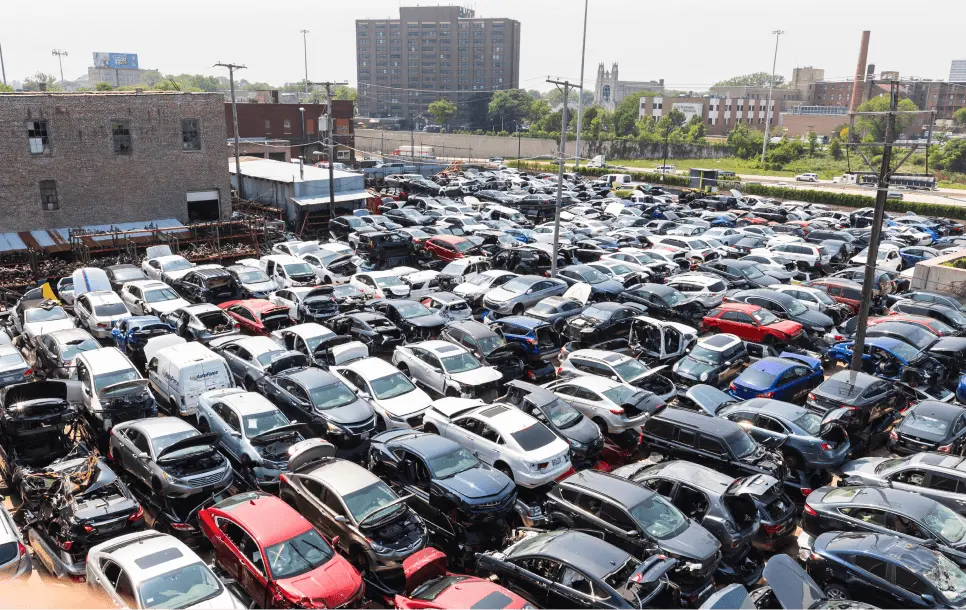
Since 1958, Aero Auto Parts has stood as an anchor of reliability in the automotive recycling industry. Operating from our central facility at 6339 S Wentworth Ave, Chicago, IL, our enterprise has spent more than 65 years refining the art and science of automotive dismantling, inspection, and wholesale component distribution.

Our 7-Point Quality Assurance Glass Protocol
Unlike unaccredited scrap yards, every glass unit harvested at Aero Auto Parts undergoes a rigid inspection matrix prior to warehouse cataloging:
- High-Intensity Optical Transmittance Test: Inspection under 5000K LED illumination to detect micro-pits, wiper arcs, or sub-surface optical distortion.
- Ultrasound Flaw Detection: Checking laminated edges for latent micro-fractures that could expand during thermal expansion cycles.
- PVB Moisture Ingress Inspection: Ensuring no milky edge discoloration exists along the perimeter seal.
- Sensor Window Refractive Verification: Verifying that rain sensor pads and camera windows are free of adhesive haze or scratch artifacts.
- Electrical Grid Conductivity Testing: Measuring resistance across integrated rear glass defrosters and antenna lines to confirm 100% circuit continuity.
- Retention Clip & Frame Integrity: Confirming door glass mounting channels and factory alignment tabs are fully intact.
- Automated VIN-Specific Cross-Referencing: Matching DOT numbers, factory tint codes, and option codes directly to OEM build sheets.
BBB A+ Credibility & Global B2B Reach
Holding a long-standing BBB A+ Rating and backed by over 330+ verified customer reviews, Aero Auto Parts provides international procurement teams with complete contract security, transparent grading reports, and custom export packing solutions.
4. Future Procurement Trends & Industry Development (2026–2030)
The global auto glass market is undergoing a seismic shift driven by environmental mandates, raw material scarcity, and vehicle architectural changes. Procurement executives who adapt to these four key macro trends will gain significant market advantages:
A. Circular Economy & ESG Scope 3 Carbon Reductions
Manufacturing a single new automotive windshield generates approximately 12 to 16 kilograms of CO2 emissions and consumes immense energy in float glass furnaces operating above 1,500°C. Sourcing recycled auto glass avoids over 90% of these embodied carbon emissions, allowing corporate collision repair networks and insurers to meet aggressive Scope 3 ESG targets and ISO 14001 compliance standards.
B. Electrochromic & Smart Solar Glass Recycling
Next-generation electric vehicles (EVs) feature massive glass roofs integrated with electrochromic dimming, embedded solar cells, and low-emissivity (Low-E) silver coatings. Because replacement costs for new smart glass units can exceed $2,500, the secondary demand for verified, tested used smart glass panels will grow at an estimated CAGR of 18.4% through 2030.
C. AI-Powered Automated Glass Matching
The era of manual part lookup is ending. B2B platforms now utilize optical computer vision and VIN-decoding algorithms to match exact glass curvature, tint codes, and sensor cutout configurations in milliseconds, reducing ordering errors and return rates to near zero.
5. Frequently Asked Questions (FAQ) — Global B2B Procurement
Q1: How does Aero Auto Parts verify structural integrity and micro-fractures in used laminated windshields?
Our engineering team utilizes specialized polarized light filters and high-intensity LED edge lighting to reveal sub-surface stress patterns and micro-cracks invisible to the naked eye. Any unit exhibiting PVB delamination, edge chips deeper than 0.5mm, or structural cracks is immediately rejected and sent to raw material recycling rather than inventory.
Q2: Why is recycled OEM glass superior to low-cost new aftermarket glass for vehicles with ADAS?
New aftermarket glass often suffers from subtle optical distortion (lens effect) and inconsistent camera mounting bracket alignment. Used OEM glass preserves the original vehicle manufacturer’s exact optical standards and bracket geometry. This guarantees that ADAS cameras align seamlessly, eliminating costly calibration retries or recalibration failures at repair facilities.
Q3: How do you read DOT numbers and glass markings to confirm authentic OEM origin?
Every automotive glass unit features a bug (monogram) stamped in a corner. The "DOT" number identifies the manufacturing plant (e.g., DOT 18 for PPG/Vitro, DOT 15 for Saint-Gobain Sekurit, DOT 22 for Pilkington). Aero Auto Parts cross-references these DOT codes and M-numbers (material/tint spec) with original factory datasheets to verify true OEM authenticity.
Q4: What export packaging protocols are used to ensure zero breakage during international container shipping?
Bulk orders of used auto glass are packed using custom heavy-duty ISPM-15 certified wooden crates. Glass panels are separated by shock-absorbing foam interlayers, rubber edge protectors, and shrink-wrap bandings. Crates are secured within ocean containers using heavy-duty strapping and moisture-desiccant packs to prevent transit breakage and humidity-induced PVB fogging.
Q5: What scratch and pit tolerance grading scale is applied to commercial used glass inventory?
Aero Auto Parts adheres to strict ARA (Automotive Recyclers Association) damage code standards. Grade 'A' used glass contains zero defects in the driver's primary vision zone (Area A) and no more than minor, non-penetrating surface specs elsewhere. Grade 'B' glass may show light surface wiper marks outside the primary vision line, making it ideal for budget-conscious fleet repairs.
Q6: How does sourcing recycled vehicle glass contribute to corporate ESG compliance?
By replacing a new glass order with a recycled OEM unit, buyers avoid approximately 12–16 kg of CO2 equivalent emissions per windshield. For collision networks handling thousands of glass repairs annually, this translates into dozens of metric tons of documented Scope 3 carbon savings, supporting corporate ESG reporting and green certification.
Q7: Can Aero Auto Parts fulfill VIN-matched bulk orders for commercial fleet operators?
Yes. Utilizing our advanced inventory management system, we allow wholesale clients to upload batch lists of VINs or part numbers. Our team pulls, inspects, grades, and packages exact-match OEM glass units for efficient single-shipment dispatch.